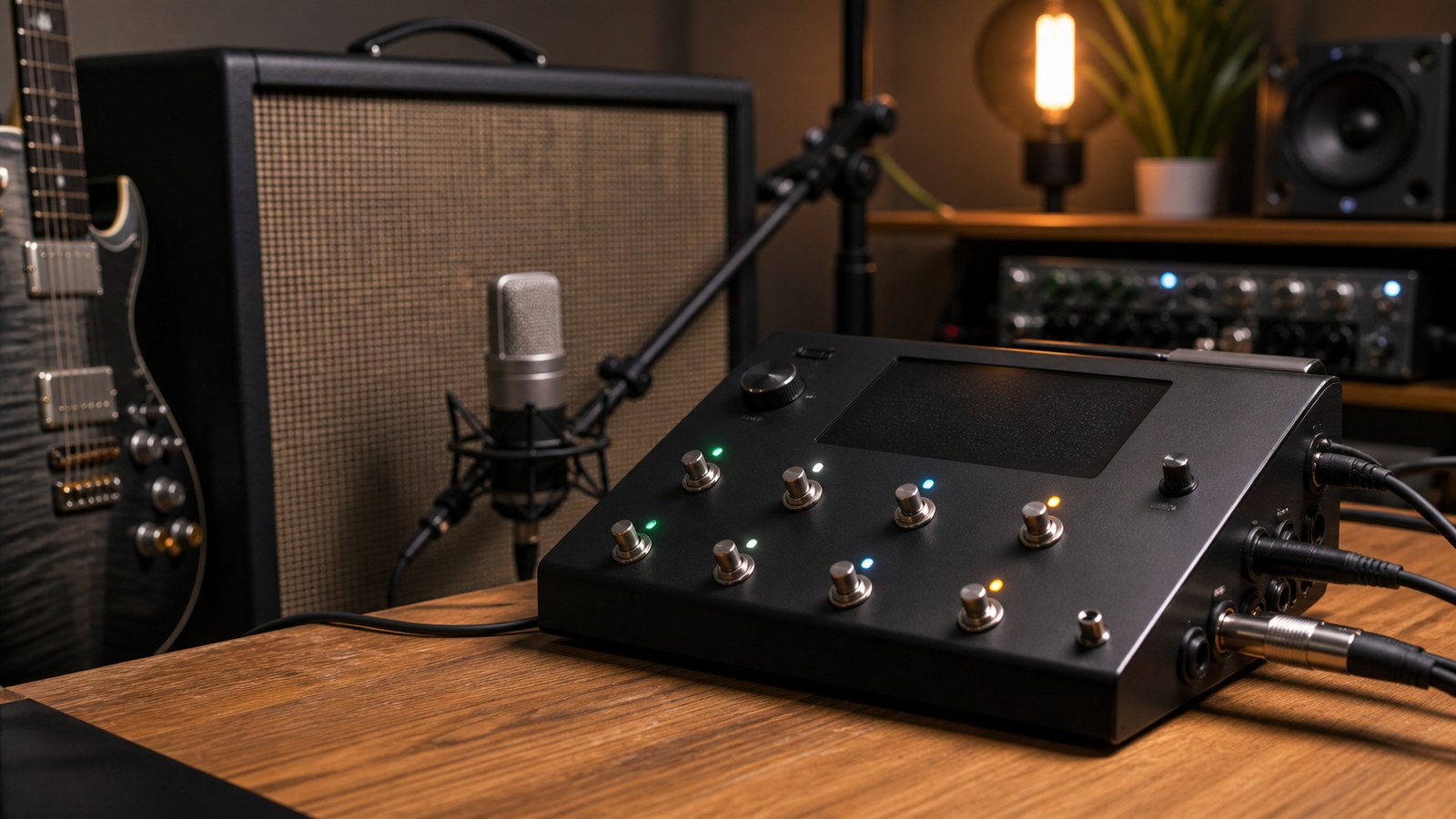
Spend ten minutes in any Quad Cortex forum and you will find someone asking whether captures or presets are better. The question is built on a misunderstanding. They are different things, used together, not alternatives. This post fixes that confusion in one read.
The short version
A capture is a model of one piece of gear. Usually an amp, sometimes a pedal, occasionally a full chain.
A preset is a snapshot of an entire signal chain. It includes everything on the grid: amp model or capture, drives, EQs, cabs, modulation, time effects, routing, and scene settings.
You load a capture into a preset. You do not load a preset into a capture. The capture is one block. The preset is the whole rig.
Captures in more depth
The Quad Cortex’s headline feature is its ability to clone amplifiers and pedals using its capture engine. You feed test signals into the real piece of gear, the unit listens to how that gear changes the signal, and the result is a digital model that responds the way the original did to picking dynamics, gain stages, and EQ.
A good capture sounds and feels like the source amp. A bad capture sounds close but feels off, often because the source amp was not isolated properly during the capture process, or because there was room noise polluting the test.
Where captures shine:
- Cloning a specific amp you cannot afford or do not own.
- Capturing a friend’s vintage head before you give it back.
- Capturing a dirt pedal you love so it lives on your unit forever.
- Capturing a signature artist tone shared on Cortex Cloud.
Where captures fall short:
- They cannot capture the cab and microphone movement together. Cab IRs handle that separately.
- They are static. The original amp’s gain, EQ, and master are baked in at the moment of capture. Changing the capture’s “knobs” inside the unit gives you EQ-style adjustment, not the same response the original amp had at different settings.
That last point is the one most people miss. If you want a Mesa Mark IV with the gain dimed and a Mesa Mark IV with the gain backed off, you need two captures, one of each setting.
Presets in more depth
A preset is everything. The captures or amp models you have placed, the drives in front, the EQ shaping, the cabs, the post effects, and how the blocks connect.
Two players using the same capture inside two different presets will sound dramatically different. The capture is the engine. The preset is the car.
Where presets shine:
- Saving a finished tone you can recall instantly.
- Designing scene-based tones for songs (verse clean, chorus dirty, bridge lead).
- Sharing a complete sound, including all routing decisions, with another player.
- Buying a polished, gig-ready rig from someone who has spent the time you do not have.
When to reach for which
You want a Marshall JCM800 sound. Reach for a JCM800 capture, drop it in your favourite preset’s amp slot.
You want a finished modern metal tone with the right cab IR, gate, drive in front, EQ baked in, and scenes for rhythm and lead. Reach for a preset.
You want to learn how someone built that modern metal tone. Reach for a preset and inspect every block.
You want one tone you have built once and can use across ten projects. Reach for a preset, save it, and copy it as a starting point each time.
How they live together
Inside one preset, you might have:
- A Tube Screamer-style drive (model or capture)
- A 5150 capture as the main amp
- A boost capture in the loop position for solos
- A cab IR loaded into a cab block
- An EQ doing surgical cuts after the cab
- A reverb and a delay at the end
That preset is built from a stack of captures and models. None of those captures is “better” than the preset. The preset is what makes them work together.
Buying captures vs buying presets
When you are starting out, buying presets is usually the better investment. You get a complete tone that someone has already balanced, and you learn by inspecting how it was built.
Once you know what you like and want to swap one element, buying captures becomes more interesting. A great Friedman capture from someone who took the time to capture three gain stages cleanly is worth its weight.
The hybrid play, which most experienced Quad Cortex users land on, is to buy a few preset packs as starting points, then collect captures as needed when a specific tone is missing.
A test you can run today
Load any preset you already own. Replace just the amp block (whether it is a capture or a model) with a different capture. Save it as a copy. Listen. The other ninety percent of the preset is unchanged, and the tone has shifted but is recognisably from the same family. That is the captures-vs-presets relationship in action.
In the next post we move from theory to practice with the settings that matter most when you are recording the Quad Cortex direct into your DAW.