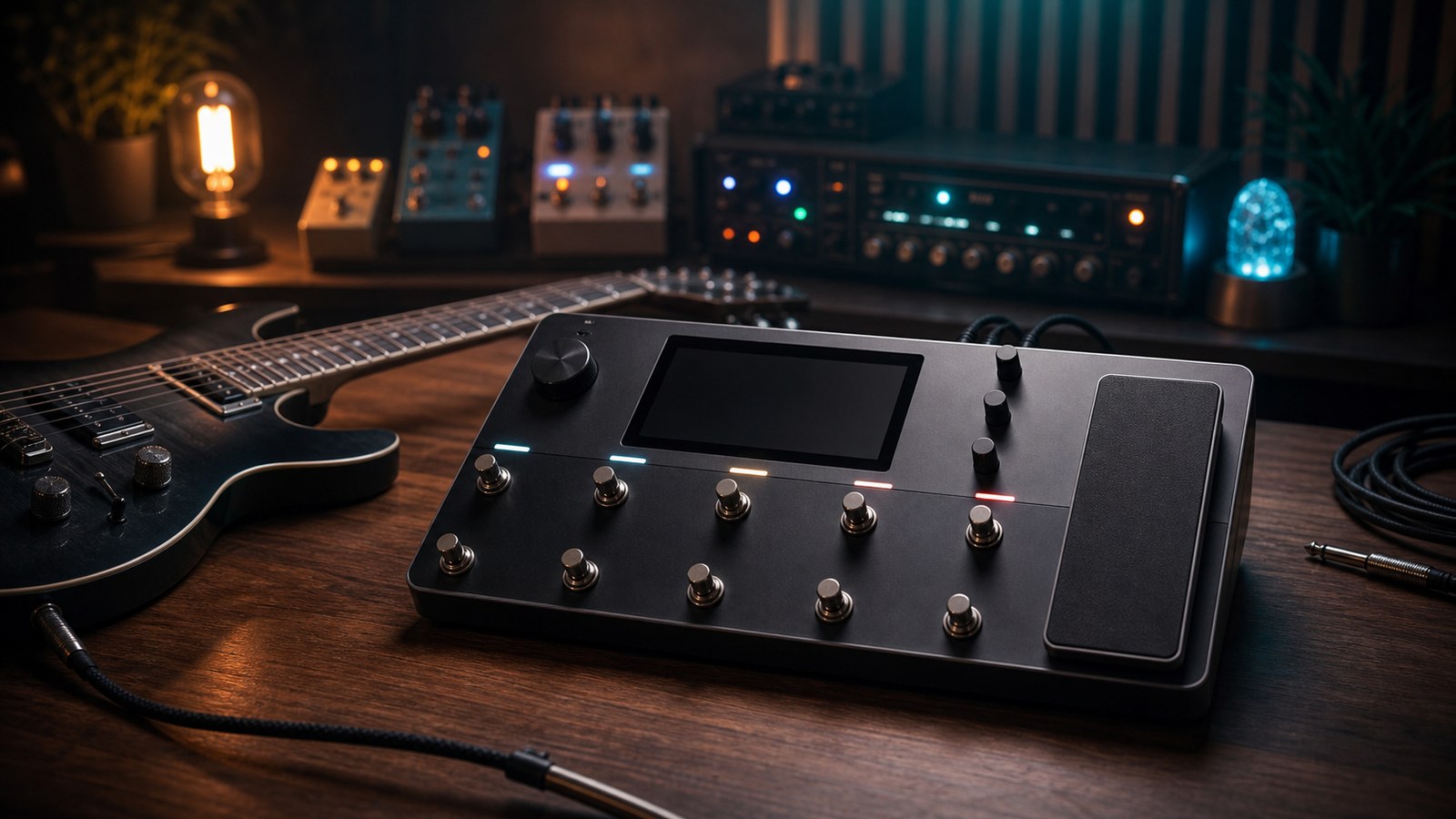
Ambient guitar is one of those styles where the Quad Cortex’s deep effects library and parallel routing genuinely show off. A good ambient preset is not just a clean tone with reverb on top. It is a network of effects that interact, reinforcing each other into something that sustains, swells, and breathes long after the strings have stopped vibrating.
Here is how we build one.
What we are aiming for
A useful ambient preset should:
- Make a single chord ring out for ten or fifteen seconds without sounding artificial
- Allow shorter phrases to layer over the sustain
- Sit in stereo without falling apart in mono
- Offer a “swell” feel where notes arrive softly rather than with a percussive pick attack
- Stay musical, never washing into a featureless drone
That is a tall order for one preset, but the Quad Cortex’s dual-path routing makes it possible.
The signal chain in plain language
The grid we use, in left-to-right order on path A:
- Light compressor
- A subtle low-gain drive (almost invisible, just for harmonic content)
- A clean amp model
- Cab IR
Then a split into two parallel paths, A and B:
- Path A continues with a tape-style delay, then a small plate reverb, then to the output
- Path B takes a tap and runs into a long modulated reverb (60 to 80 percent wet), then a granular or shimmer effect, then to the output
The output blends path A and path B, with path A around 80 percent and path B around 30 percent. The exact balance is a taste call.
Block one: the compressor
We start with a gentle compressor purely to glue dynamics. Settings:
- Ratio: 2:1 to 3:1
- Threshold: enough to catch the loudest picked notes, around 4 to 6 dB of gain reduction
- Attack: medium-slow, so picking transients survive
- Release: medium
The goal is to even out the strongest picks slightly, not to obviously compress. If you can hear the compressor pumping, back it off.
Block two: the subtle drive
This is the secret sauce. A drive set so its volume change is minimal but with the drive knob low and the level just above unity adds harmonic complexity to a clean tone. Without it, ambient cleans can sound flat. With it, the harmonics sustain longer and pair beautifully with reverb tails.
Use a low-gain transparent overdrive. A Klon-style or a TS-style with the drive at minimum and the level pushed.
Block three: the amp
Pick a clean amp with character. A Fender Twin or Deluxe-style capture works. Vox AC30 captures are also wonderful here, especially if your guitar has humbuckers.
Set the amp clean. Gain low, treble moderate, presence low, bass moderate. You want the amp’s clean tone with its natural compression, not a roar.
Block four: cab IR
For ambient, a cab IR with a slightly softer high end is your friend. Single 12-inch speaker IRs (Twin, Deluxe, or single-mic’d 4×12 IRs at warmer mic positions) work well. Avoid bright Mesa-style 4×12 IRs that push too much treble.
The split into parallel paths
This is where ambient stops being a clean tone with reverb and starts being a soundscape.
After the cab, split the signal into two paths. The Quad Cortex makes this trivial via its grid layout. One path stays mostly intact (path A). The other path becomes pure atmosphere (path B).
Path A: the structure
Path A keeps the recognisable guitar tone alive. We add:
- A tape-style delay set to dotted eighth or quarter, with feedback around 25 percent and mix around 25 to 30 percent. Modulation slight, just enough to give the repeats character.
- A small plate reverb. Decay around 1.5 seconds, mix at 20 percent. Just enough to put the guitar in a room.
Path A is what carries the actual notes and chords. If path B disappeared, path A on its own would still be a beautiful ambient clean.
Path B: the atmosphere
Path B is where the magic lives. It takes a small portion of the signal and turns it into pads.
- A long modulated reverb. Decay 6 to 8 seconds, modulation rate slow, modulation depth moderate. Mix on this block at 80 percent or higher (it is a parallel send, so high mix is correct).
- A shimmer or granular effect after the reverb. Pitch up an octave, mix around 50 percent.
- A high-pass filter at the end of the path to remove low-frequency mud, around 200 Hz.
This path produces a cloud of harmonised wash that follows behind your playing. Because it is parallel, it does not muddy the main tone. Because it is high-passed, it does not fight the bass register.
Output blend
Sum path A and path B at the output. Path A drives the take. Path B sits behind it. Adjust to taste, but a rule we like: turn path B up until you notice it, then back it off two dB. Atmosphere should be felt before it is heard.
Scenes for an ambient preset
Build three or four scenes that change the personality without rebuilding the chain:
- Default: the chain as described
- Big: path B mix up by 6 dB, delay feedback up to 35 percent
- Intimate: path B muted, only path A active
- Swell: an extra envelope filter or volume swell engaged on path A
Switching between scenes lets a single preset cover a quiet verse, a soaring bridge, and a stripped-back outro.
Practical tips
Roll your guitar’s volume back to 7 or 8 when you are using an ambient preset. The drive block is sensitive to input level, and a slightly attenuated guitar volume cleans up beautifully and leaves you headroom for swells.
Use a volume pedal or expression pedal mapped to an output trim. Slow swells are an enormous part of the ambient vocabulary.
Practice with a metronome, even on ambient. The trap of long delays is that you stop hearing the rhythm. The discipline of staying tight to a click is what separates ambient music from ambient noodling.
In our next post we are going to explain why cab IRs are the single highest-impact block in your chain, and how to choose one that will actually sit in a mix.