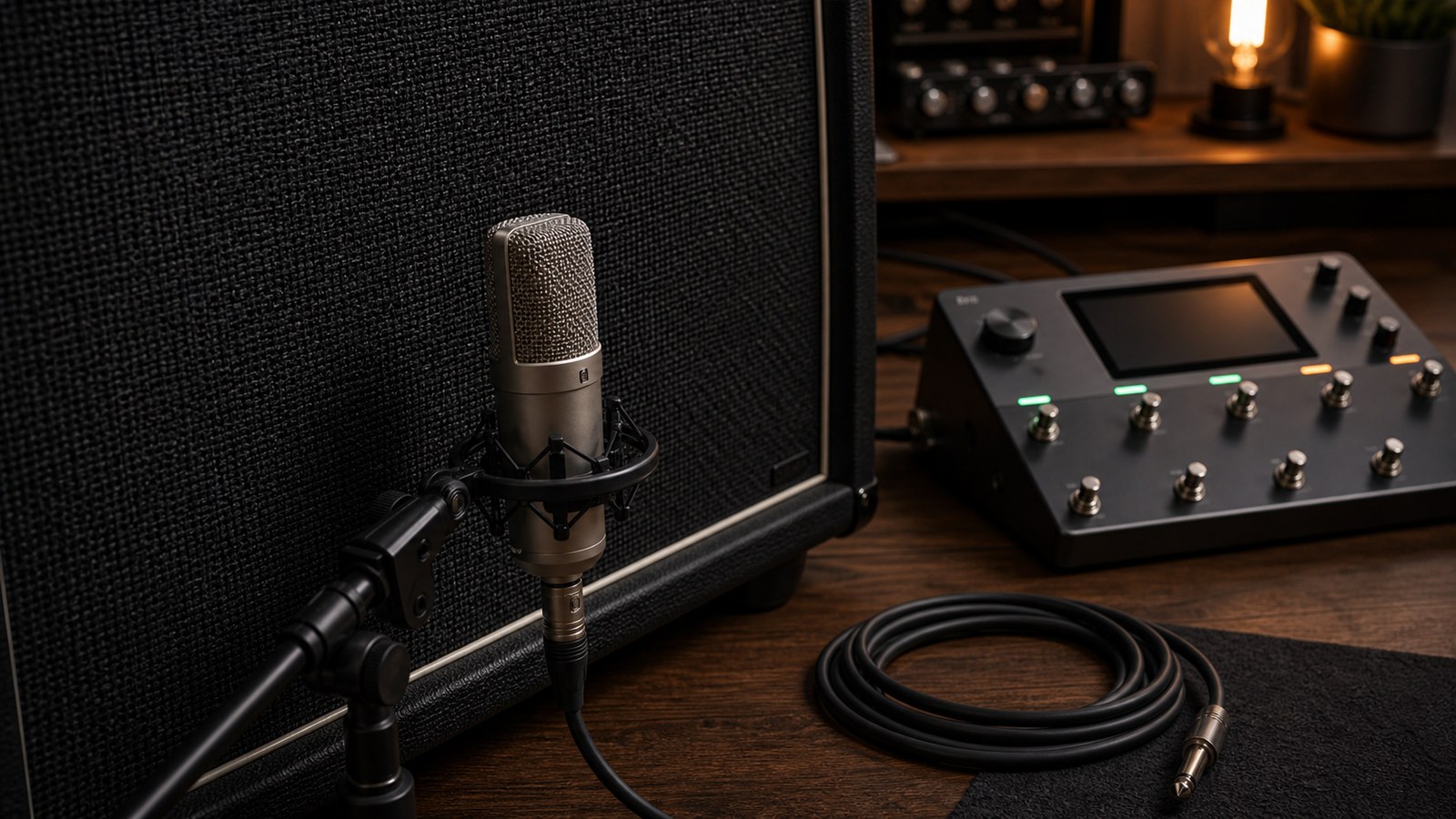
If you swap an amp model in a preset, the tone changes a little. If you swap a drive pedal, the tone changes a little. If you swap the cab IR, the tone changes completely. The cab block is the single most influential element in a Quad Cortex chain, and the difference between a good preset and a great one almost always lives there.
This post is a practical guide to cab IRs: what they are, how to choose them, and how to audition them without falling into the most common traps.
What an IR actually is
An impulse response is a short audio file that captures how a speaker cabinet, a microphone, and a room interacted at one moment in time. When the Quad Cortex’s cab block applies an IR, it is essentially convolving your guitar signal with that captured behaviour. The result is the same EQ shape, room behaviour, and microphone colour you would have got if you had recorded through the original setup.
A cab IR is not a model of an amp. It does not change distortion. It changes EQ, frequency response, and the spatial character of the sound. That is enormous, because most of what you hear as “amp tone” is actually the cab and microphone, not the amp.
Why the cab matters more than the amp
Run two completely different amps through the same cab IR. They will sound clearly different but unmistakably from the same speaker. Run the same amp through two completely different cab IRs. They will sound like two different rigs.
This is the practical point: if your tone is not sitting right, the first thing to swap is not the amp, the gain, or the EQ. It is the cab IR. Most “wrong” Quad Cortex tones are amps paired with the wrong cab.
What lives inside a good IR
A high-quality cab IR has been recorded with attention to:
- A real cabinet in a real space (not a re-amped studio test)
- Microphones placed where a real engineer would place them
- A neutral or known-good signal chain into the recording
- Optional blends of multiple microphones for a fuller tone
- Mic distance options for tracking different applications
Cheap or free IRs sometimes skip all of these. They might be a single SM57 jammed against the cone with no thought about phase or distance. Those IRs work for quick demos but will fight you in a mix.
The mic positions you will see
Most professional IR packs ship with multiple positions. Knowing what each one does saves time:
- Cap-edge. Bright, articulate, the most common rock and metal position. Picks up fizz if the amp has any.
- Cone-edge. Softer high end, more midrange body. Good for cleans and lower-gain rhythm tones.
- Cone-centre or “on-axis”. Bright, sometimes harsh. Useful for cutting in a busy mix, less pleasant alone.
- Off-axis. Smoother, darker. Often the secret to a great clean tone or a vocal-friendly rhythm tone.
- Room. A microphone placed several feet back, capturing the cab in a space. Adds depth, especially in stereo.
Many IR packs include a “blend” file that has already mixed two or three positions for you. Use these as starting points and tweak by swapping individual positions if the blend is not quite right.
Single mic vs blend IRs
A blend IR sums multiple microphone takes into one file. A single mic IR is one position only.
Blend IRs are convenient and often sound great immediately. They are harder to fix in a mix because you cannot pull back any one element.
Single mic IRs let you build your own blend by running two cab blocks in parallel with different IRs and balancing them. This is closer to how real engineers track guitars, and the results are generally more flexible at mix time.
For a starting Quad Cortex user, blend IRs are easier. For someone who tracks regularly, single mics in parallel give more control.
How to audition cab IRs properly
The single biggest mistake people make is auditioning IRs in isolation. You load an IR, the guitar sounds great, you save the preset, and then in a full mix the guitar disappears. Why? Because the IR sounded great alone but had too much low-mid build or no upper-mid presence.
The right way to audition cab IRs:
- Open a backing track or a rough mix of the song you are working on.
- Record a take of the rhythm part with a placeholder IR.
- Mute the placeholder track and start swapping IRs while the mix plays.
- Pick the IR that sits in the gaps the song leaves for guitar.
You will almost always end up with an IR that sounds slightly thin or slightly bright in solo. That is correct. Solo guitar tones do not survive in mixes. Mix-ready tones often sound boring on their own.
Stacking cab blocks for tracking
For double-tracked rhythm guitars, a trick we use often: load two cab blocks in parallel, each with a different IR, panned slightly off-centre. This produces a single tracked guitar that already has the spatial spread of a double track. It is not a substitute for actually double-tracking, but for demos and one-take overdubs it is a huge upgrade over a single mono cab block.
When to leave the IR alone
Some Neural DSP plugins running natively on the Quad Cortex bring their own bundled cabs that have been chosen by the plugin’s designer. If you are using one of those plugins and the cab section is part of the plugin, swapping a Quad Cortex cab IR after the fact may not always be the right move. The plugin’s cab is part of the artist’s vision. By all means experiment, but recognise when the bundled cab is good as it ships.
A note on phase
If you are running two cab IRs in parallel, listen carefully for phase issues. Try summing them in mono (most monitor controllers have a mono button) and see if any frequencies disappear. If they do, invert the polarity of one cab block and listen again. The Quad Cortex has a polarity flip on cab blocks for exactly this purpose.
Coming next
In the next post we tackle the topic that ties amps, drives, and cabs together: gain staging. If your tones are too thin, too compressed, or too noisy, the answer is almost always somewhere in the gain structure of your chain.
How Cab IRs Shape Your Quad Cortex Tone