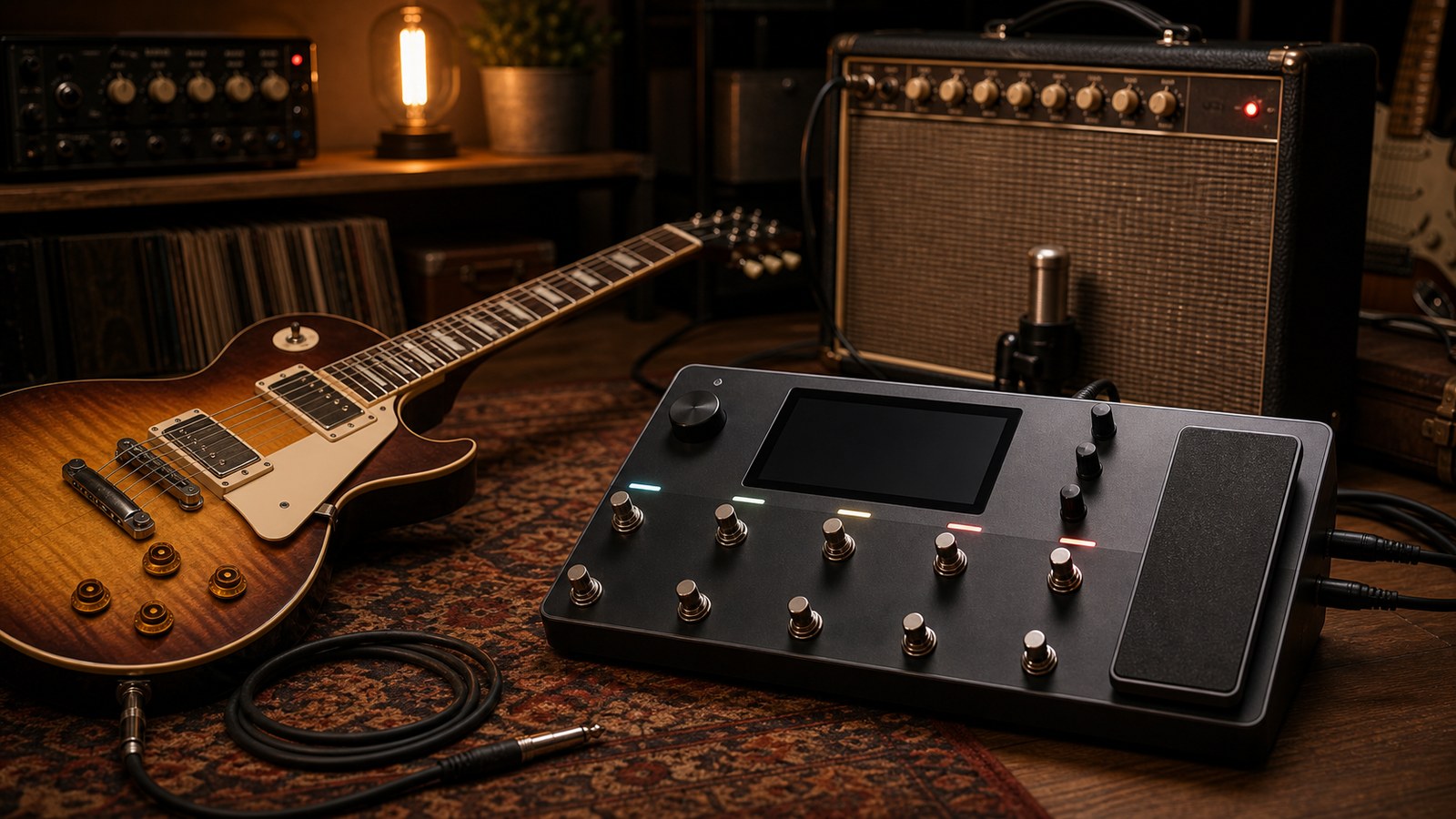
The Quad Cortex gets associated with modern metal, but its lower-gain amp models and classic captures are some of the most rewarding tones the unit produces. Done well, a classic rock or blues preset on the Quad Cortex breathes and responds to picking dynamics in a way that recalls the original tube rigs it is modelling. Done poorly, it sounds like a guitar tone someone copied from a YouTube video.
Here is how we approach vintage tones.
What classic rock and blues tones actually are
The defining quality of a great vintage tone is dynamic response. The amp is not at maximum gain. It is in the sweet spot where:
- Light picking produces clean or barely-broken-up tones
- Medium picking produces warm, harmonically rich crunch
- Hard picking produces full saturation and compression
- Volume changes on the guitar smoothly clean up or dirty up the sound
This is fundamentally different from a high-gain tone, where the amp is at maximum saturation regardless of picking input. A vintage tone is responsive. A modern tone is reliable.
If your classic rock preset sounds the same regardless of how hard you pick, you have the gain too high.
The chain
For most classic rock and blues tones:
- Optional light compressor (often skipped entirely)
- Optional drive or boost in front of the amp
- A vintage amp model or capture
- A cab IR matched to the amp era
- Light room reverb or spring reverb
- Output
Note what is missing: aggressive gates, screamers with the drive at zero, surgical post-cab EQ. Vintage tones are simpler because the dynamic response of the amp is doing most of the work.
Block one: compressor (optional)
Most vintage tones do not need a compressor. The amp’s natural compression at saturation handles dynamics. If you do use one, it is for evening out fingerstyle or slide work, not for adding sustain.
If you compress:
- Ratio: 2:1
- Threshold: light, around 2 dB of gain reduction
- Attack: medium-slow
- Release: fast
Some players use a vintage-style optical compressor (LA-style) for that “always-on” pillowy compression heard on old country and blues recordings. The Quad Cortex has captures of these.
Block two: the drive (optional)
A drive in front of a low-gain amp is the classic recipe for cranked-amp tones at lower volumes. Common choices:
- A Klon-style or transparent boost (mostly volume, slight EQ)
- A Tube Screamer (slight midrange push)
- A treble booster (Brian May / Rangemaster style)
- A fuzz pedal (Hendrix territory)
Unlike high-gain tones, the drive’s drive knob is doing real work here. Set the drive knob in the 9 to 12 o’clock range, the level around unity, and let the drive contribute its character.
Plate captures of real vintage drives (a real Klon, a vintage Tube Screamer, an Arbiter Fuzz Face) are widely available on Cortex Cloud and are worth using if you want the most authentic feel.
Block three: the amp
The amp choice is the heart of a vintage tone. Common starting points:
- Fender Twin Reverb capture. Loud cleans, no overdrive. Pairs with a drive in front for almost any country, blues, or classic rock tone.
- Fender Deluxe Reverb capture. Smaller, breaks up earlier, gorgeous for blues.
- Vox AC30 capture. Chimey, midrange-forward, the classic British clean and crunch tone.
- Marshall JTM45 capture. Plexi territory, low gain, dynamic, the foundation of British rock.
- Marshall Plexi (1959SLP) capture. Slightly higher gain than the JTM45, more aggressive in the upper-mids.
- Marshall JCM800 capture. The classic 80s rock amp, more gain than the Plexi but still dynamic.
- Hiwatt DR103 capture. Loud, clean headroom, muscular midrange, the classic Pete Townshend sound.
Settings for any of these:
- Gain: 3 to 5. The amp should clean up almost completely when you roll your guitar volume back to 5.
- Bass: 5 (these amps are often too dark with the bass below 5)
- Mids: 6 to 7 (vintage tones thrive on midrange)
- Treble: 5 to 6
- Presence: 5
- Master: as needed for level
These settings produce a tone that sounds rich at full guitar volume and clean at half. That is the vintage sweet spot.
Block four: the cab IR
Vintage tones need vintage cab IRs. Specifically:
- 4×10 cab IRs (Bassman style) for blues and country
- 1×12 or 2×12 combo IRs for Vox and Fender amp types
- 4×12 with Greenbacks for Marshall amp types
- Avoid V30-loaded 4×12 IRs for vintage tones. Those are modern speakers in a vintage cabinet, and the result is too aggressive in the upper-mids.
Microphone choice matters more on vintage cab IRs than modern ones. Look for IRs with a Royer ribbon mic, a U67 condenser, or an SM57 placed cap-edge or off-axis. Avoid IRs labelled “on-axis” only, which can sound brittle on vintage amps.
Block five: reverb
Spring reverb is the classic vintage choice. Set the spring reverb’s mix around 15 to 25 percent and dial in the decay until it feels natural without becoming the dominant sound.
If the song calls for a bigger space (dramatic ballads, cinematic blues), a small plate reverb works as well. Avoid hall reverbs, which usually feel wrong on vintage tones.
A few specific tones
Stevie Ray Vaughan-style blues. Tube Screamer at 9 o’clock drive, level above unity. Fender Twin Reverb capture, gain at 3, mids at 7. 4×10 cab IR. No reverb (he often played dry).
Hendrix-style fuzz. Fuzz Face capture (Germanium variant), drive maxed. Marshall Plexi capture, gain at 4, mids at 6. 4×12 Greenback IR. Subtle spring reverb.
Slash-style rock. No drive. Marshall JCM800 capture, gain at 6, mids at 7. 4×12 Greenback IR. No reverb (it should be added in the mix or by the venue).
Vox-style chime. No drive (or a treble booster). Vox AC30 capture, gain at 4, mids at 7. 2×12 cab IR with a U67-style mic. Spring reverb at 20 percent.
Country chicken-pickin’. Light compressor. Fender Telecaster (the guitar matters here). Fender Deluxe Reverb capture, gain at 3, treble at 7. 1×12 cab IR. Spring reverb at 30 percent.
The volume knob is your second tone control
The biggest difference between vintage and modern tones in practice is the volume knob. Modern tones are dialled in once and stay there. Vintage tones rely on the player rolling the volume knob during the song to clean up or dirty up.
Practice this. A classic rock or blues preset is meant to be played dynamically, not statically. If you never touch your volume knob, you are missing half of what makes the tone work.
In our next post we move to clean and worship territory, where shimmering tones, swells, and pad-like textures live.