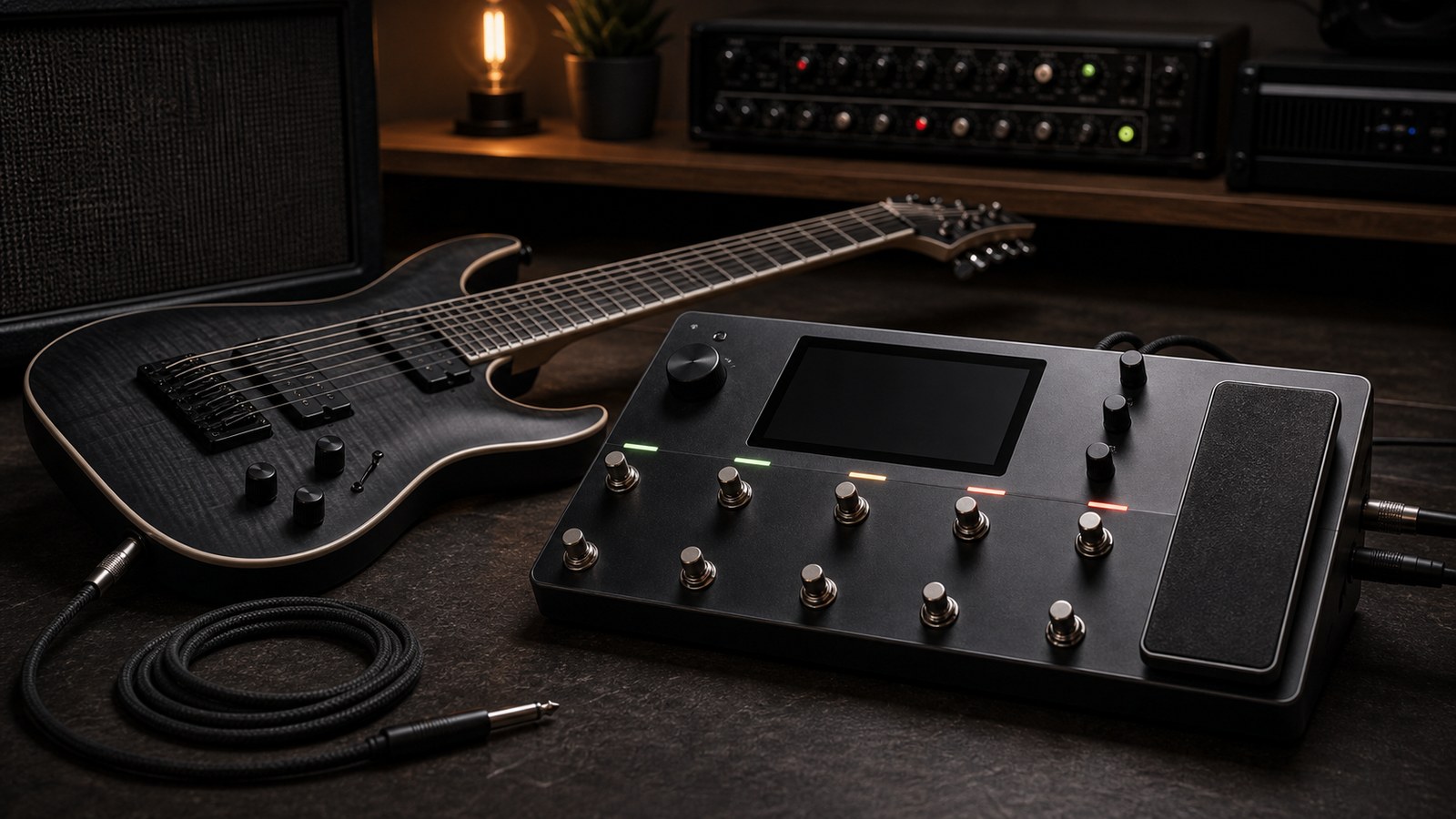
Djent is a tone genre as much as a music genre. The defining sound is tight, percussive, almost dry, with a low end that hits like a kick drum and a midrange that cuts through everything. Getting this right on the Quad Cortex is straightforward if you understand which choices matter and which are decoration.
What separates djent from regular metal
The two distinguishing characteristics of a djent tone:
- Tightness in the low frequencies. Palm-muted notes have to articulate cleanly even on a low B or A string. Anything that introduces flab below 200 Hz kills the tone immediately.
- Almost no audible saturation tail. When you mute a chord, it dies instantly. The aggression comes from the picking attack, not from prolonged sustained distortion.
If your tone has too much sustained noise after a palm mute or too much low-end mud, you have a metal tone, not a djent tone.
The chain
Top to bottom:
- Aggressive noise gate
- A boost or Tube Screamer with drive at zero, level pushed
- A high-gain amp model or capture, run at moderate-to-high gain (not maximum)
- A 4×12 cab IR with a V30-style speaker and a close mic position
- A parametric EQ doing surgical cuts
- Output
This is not radically different from any high-gain chain. The trick is in the parameter values, not the block selection.
Block one: the gate
The gate is more aggressive in djent than in regular metal. You want fast cut-off so palm-muted gallops sound like staccato pulses, not bleeds.
Settings:
- Threshold: minus 45 to minus 40 dBFS (higher than for general metal)
- Hold: 10 to 20 ms (short)
- Release: 50 to 80 ms (fast)
Test by playing your tightest palm-muted gallop. The gate should snap shut between every note. If you hear any sustained signal between palm mutes, raise the threshold.
The downside of an aggressive gate is that it can chop the start of a held note if you transition too quickly. The fix is footswitching the gate off momentarily for ringing-out parts, or using a less aggressive gate setting on a separate scene.
Block two: the screamer
A Tube Screamer in front of a high-gain amp is essential for djent. Setting:
- Drive: 0 (yes, zero)
- Tone: noon
- Level: maxed or slightly above unity
The drive at zero is correct. You are not using the screamer for distortion. You are using it as an EQ shaper that tightens the low end and pushes the midrange. The level knob is doing all the work, slamming a tighter, more midrange-focused signal into the amp.
If your sound is too bright with the screamer, lower the tone slightly. If it is too dark, raise it.
Some players use a Maxon OD808 or similar instead. The behaviour is identical to a TS9 for this purpose.
Block three: the amp
Common djent amp choices:
- 5150 / 6505 capture (the standard)
- Diezel VH4 capture (slightly more refined)
- Mesa Mark V capture (tightest low end of the three)
- Friedman BE100 capture (slightly older voice but works for the right song)
- Engl Powerball capture (aggressive, modern, scooped)
Settings:
- Gain: 6 to 7. Yes, that is lower than you think you need. The screamer is doing a lot of work, and lower gain feels tighter and more responsive.
- Bass: 3 to 4 (lower than for regular metal)
- Mids: 4 to 5
- Treble: 5 to 6
- Presence: 5 to 6
The single most common djent tone mistake is dimed gain. Less gain feels heavier in the mix because it is tighter. Trust this and back the gain off.
Block four: the cab IR
For djent specifically, look for cab IRs that emphasise:
- Mid clarity (around 1 to 2 kHz)
- Tight low end with no excessive bass below 100 Hz
- Slightly reduced “fizz” range above 5 kHz
- Mesa or V30-loaded 4×12 cabinets
A great djent cab IR sounds slightly thin in solo. In the mix it sits perfectly. If your cab IR sounds enormous and full alone, it will fight bass and drums in a mix.
Some preset packs are explicitly designed for djent and bundle the right cab IRs. Save yourself the auditioning time and use one as a starting point.
Block five: the post-EQ
A surgical EQ after the cab block lets you fix the small problems specific to your guitar.
Common djent EQ moves:
- High-pass at 100 Hz to remove sub-rumble
- Cut around 250 Hz by 2 to 3 dB to clear muddiness
- Slight cut around 4 to 5 kHz if the tone fizzes
- Slight boost around 2.5 kHz for note articulation
- Low-pass at 8 to 9 kHz to tame digital edge
Tweaks here are small. Big EQ moves usually mean the cab IR is wrong.
Extended range considerations
If you are playing seven-string, eight-string, or low-tuned six-string, the chain stays the same but a few values change:
- High-pass at 90 Hz instead of 100 Hz, but never lower than 80 Hz
- Cut around 200 Hz instead of 250 Hz, where the muddiness shifts on lower tunings
- Consider a slightly tighter screamer (level pushed even harder, drive still at zero)
Below low B, low end management becomes critical. The temptation is to add bass to make the low strings feel huge. Resist it. Tightness comes from less low end, not more.
Stereo for djent
Djent guitars in a mix are almost always double-tracked, with two performances of the same part panned hard left and right. The Quad Cortex makes this practical because dry signals can be re-amped through the same preset to fake a second take if your second performance is not quite as tight.
For tracking, do not use stereo widening tricks on a single take. They never sound as convincing as two real takes.
A note on captures vs models
Whether you use a capture of a real 5150 or the Quad Cortex’s built-in 5150-style amp model is largely a taste call. Captures from well-known engineers (the producers who actually mix this music) are often very good and worth seeking out on Cortex Cloud. The unit’s built-in models are also competitive and require zero downloading.
If you have a specific producer’s record you are chasing the tone of, search Cortex Cloud for that producer’s name. Several engineers active in the djent world have shared captures of their actual studio rigs.
A starter preset
If you want to skip the dialling, our djent preset packs include rhythm and lead presets matched for double-tracked use, with cab IRs already vetted for mix-readiness. Loading one of those is a faster route to a finished tone than starting from scratch.
In the next post we change direction completely, leaving the modern world for classic rock and blues tones, where the Quad Cortex’s lower-gain models really shine.