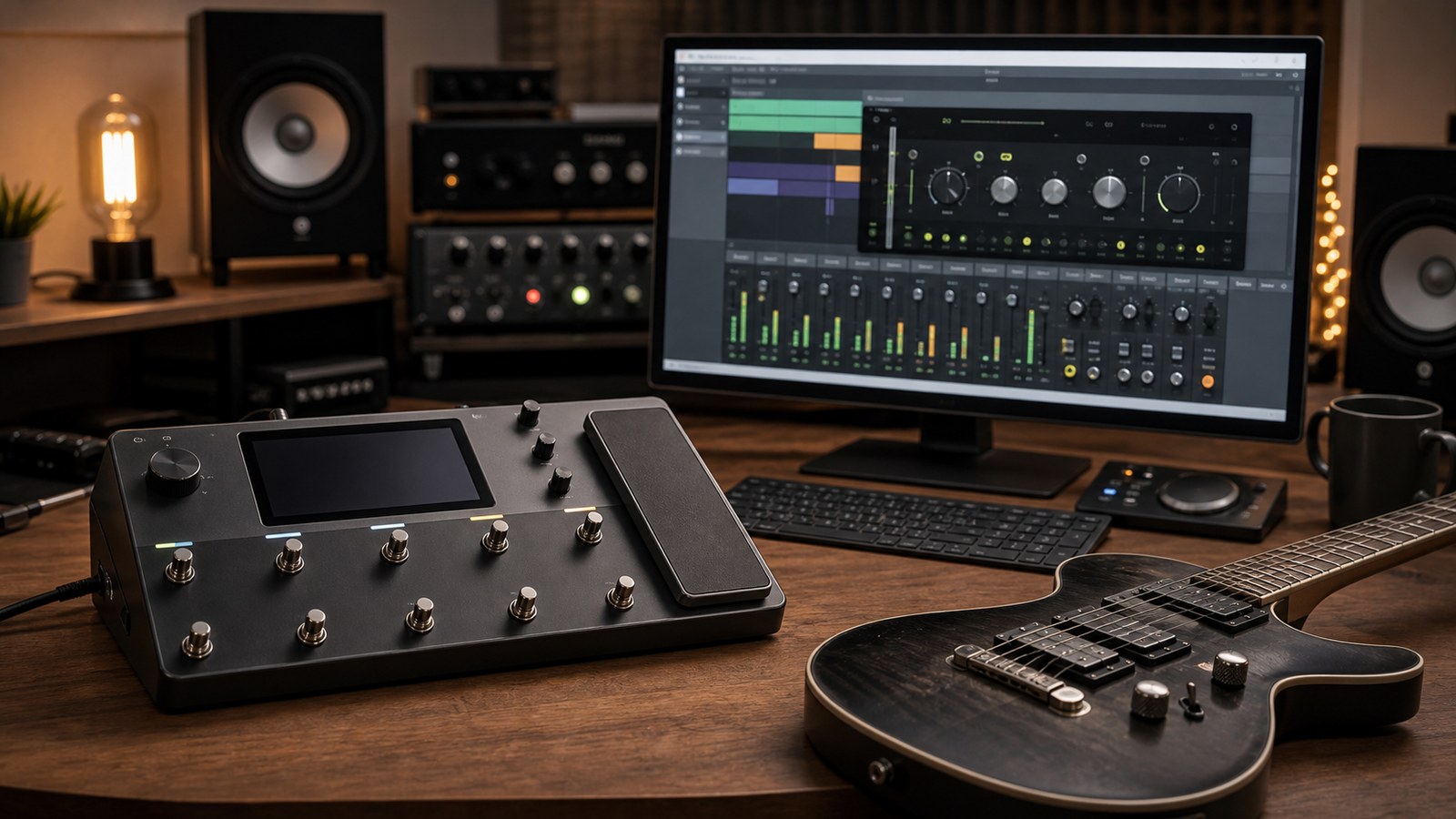
If you are deciding between a Quad Cortex and a Neural DSP plugin, the marketing will not help you. Both promise studio-grade tone. Both have artist endorsements. Both can sit at the centre of your rig. The honest answer to which one you should buy is: it depends on what you are actually doing with it.
There is also one important wrinkle that has shifted this conversation since the Quad Cortex first launched. Neural DSP now supports many of their paid plugins running natively on the Quad Cortex itself, with more being added on a steady release cadence. So the framing of “hardware versus plugins” is partially obsolete. The real question is whether you need the plugin in your DAW, on your unit, or both.
We use both, on the same projects, often on the same songs. Here is how we choose between them.
What each one is good at
The Quad Cortex is a self-contained piece of hardware. It runs without a computer, holds your tones inside the box, and is built to survive being hauled to a gig. Its capture engine lets you model real amps and pedals as capture blocks that you drop inside a preset. It works as an audio interface, so it can also be your tracking front end at home. And it can run a growing list of Neural DSP’s paid plugins (Archetype titles and beyond) natively on the device, so your Plini or Nolly tones are not stuck in your DAW.
Neural DSP plugins originated as software amp simulators that run inside your DAW. The Archetype range covers signature artist rigs (Plini, Nolly, Gojira, Petrucci, Tim Henson, Rabea and others). The plugins are deeply tweakable, integrate with mix sessions through automation and side-chains, and update on the same release cadence as the rest of your software. Many of these same plugins now also load directly on the Quad Cortex, sharing a tone library across hardware and DAW.
Neither is strictly better. They are different surfaces for, increasingly, the same underlying tone engines.
Choosing based on what you do most
You play live. Quad Cortex, every time. Carrying a laptop on stage is a recipe for problems, and the unit is built around live workflows: scenes, MIDI control, redundant outputs, expression pedal input.
You record at home and rarely play live. Plugins are usually the better value. You skip the hardware cost, you can run multiple instances on the same project, and your tone is recallable inside a session forever, even five years later.
You record a lot and want one signal chain everywhere. Quad Cortex is the cleanest answer, especially now that many Neural DSP plugins run natively on the unit. Build the tone on the unit, recall it inside your DAW with the matching plugin, and you have the same rig at home, on stage, and in a friend’s studio.
You are a producer working on many genres. Plugins, plural. Buying the Archetype that fits each project is faster than building everything inside one device, and the same licences will increasingly run on the unit when you need them there.
You play a lot of capture-based tones. Quad Cortex. The capture engine is the unit’s headline feature for a reason. You can clone an amp at a friend’s studio in twenty minutes and bring that tone home.
Latency and feel
Plugins are good. They are not as low-latency as a hardware modeller plugged in direct. You can mitigate this with low-buffer settings and a quality interface, but on a borderline rig you will sometimes feel a millisecond or two of slop, especially on tight palm-muted parts.
The Quad Cortex feels like a tube amp under your fingers. That feel is the strongest argument for the unit if you are coming from analogue gear and have been put off by software in the past.
Reliability and lifespan
Hardware ages. Software ages differently. A Quad Cortex you bought today should run for a decade, but it is one device with one set of components. A plugin licence depends on whether the company is still around, whether they support your future operating system, and whether you keep your authorisations in order.
In practice, Neural DSP is a healthy company and their plugin licences have been honoured cleanly through several macOS and Windows generations. We do not lose sleep over either platform’s longevity, but a hardware unit is the more durable artefact.
Workflow differences worth knowing
Quad Cortex tone changes happen on a touchscreen. Plugins happen with a mouse. The mouse wins for fine adjustments. The touchscreen wins for confidently locking a tone before you forget what you were going for. Many of us prototype on the unit and finalise in the plugin.
Plugins integrate with mix automation. You can ride drive amount across a chorus, automate cab IR swaps, or sidechain a compressor to the kick. The Quad Cortex can be ridden by MIDI and expression, but DAW automation is more granular by miles.
The Quad Cortex’s Cortex Cloud is a real social network for tones. People share captures and presets every day. The plugin ecosystem is more closed, with packs sold through marketplaces rather than community libraries.
What we recommend
If you only buy one and you play live: Quad Cortex.
If you only buy one and you only record: a couple of Archetypes that match your style. Buy the artist whose tones you actually chase, not the one with the most YouTube views.
If you can afford both: the Quad Cortex for tracking and live, plugins for fast prototyping and mix flexibility. They make each other better, and with native plugin support on the unit, the line between them keeps thinning.
Where presets fit
Whichever path you take, a quality preset pack accelerates your tone hunt. Presets for the unit are loaded onto the hardware. Presets for plugins are loaded inside the DAW. We make packs for both, designed for each format rather than ported from one to the other.
In the next post we are going to drill into something the Quad Cortex does that the plugins do not: captures. If you have ever wondered whether to use a capture or a built-in amp model in your next preset, that one is for you.